
Numeraire (NMR) Cryptocurrency Soars After JPMorgan Invests $500 Million in AI Tokens

- Numeraire rises 100% after contribution from JPMorgan
- AI Tokens Reach $29,4 Billion in Value
- Jamie Dimon softens criticism and opens space for cryptocurrencies
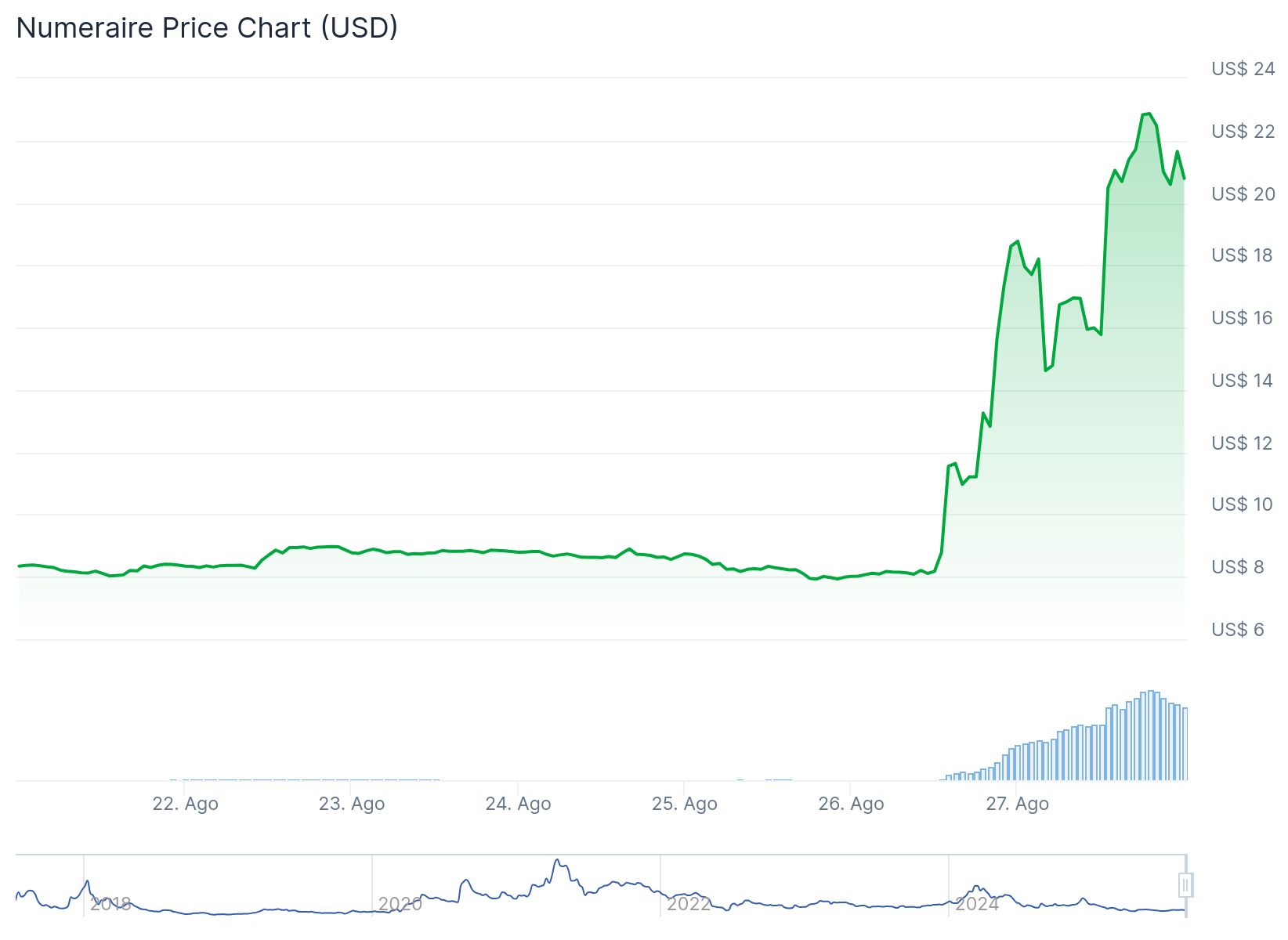
The Numeraire (NMR) token, linked to the Numerai hedge fund, saw a strong surge in value after JPMorgan Asset Management confirmed its commitment to allocate $500 million to the project. The move placed the asset at the center of the artificial intelligence token market, a sector that has regained momentum this week.
According to data, the NMR cryptocurrency soared more than 100% in just 24 hours, trading at around $23. This performance placed the cryptocurrency as a standout among AI assets, which together advanced 5,8% in the same period, reaching a market value of $29,4 billion.
The breakthrough occurred even after Nvidia disclose second-quarter results below expectations. The North American company, a leader in artificial intelligence hardware, is often seen as a bellwether for the sector.
Founded in 2015, the Numerai adopts a unique model in the financial market, crowdsourcing predictions from data scientists. Participants compete in cryptographic tournaments to predict stock prices, receiving NMR rewards for the best performances. This strategy has already attracted renowned investors such as Paul Tudor Jones, Naval Ravikant, and Howard Morgan, co-founder of Renaissance Technologies.
In the hedge fund industry, the term "capacity" means that an investor guarantees access to a fund with a pre-defined value, even if new contributions are limited in the future. This practice signals a capital commitment, even if the funds are not immediately transferred.
JPMorgan's involvement with Numerai also reflects a shift in the bank's stance on cryptocurrencies. CEO Jamie Dimon, who in the past called Bitcoin a "fraud" and compared digital assets to "decentralized Ponzi schemes," has adopted a more flexible tone. In May, he stated that, while he does not personally support Bitcoin, he allows the bank's clients access to the asset. In June, the institution revealed it was evaluating cryptocurrency-backed loans and credit products secured by digital assets.
Disclaimer: The content of this article solely reflects the author's opinion and does not represent the platform in any capacity. This article is not intended to serve as a reference for making investment decisions.
You may also like
APT breaks resistance, CRYPTO ME targets $4 if support at $0.75 holds
Multiple Factors Weigh In, Intensifying U.S. Treasury Sell-Off! 5-Year Yield Breaks 5% for the First Time Since 2007, 10-Year Yield Surpasses 5.1%
The stronger-than-expected U.S. September PMI, international crude oil prices returning above $100, and Fed governors signaling possible rate hikes have all negatively impacted the bond market. The disappointing 5-year Treasury auction has further worsened market sentiment. The psychological barrier of a 5% yield on the 10-year U.S. Treasury is losing its significance as a "ceiling," with the market now starting to discuss a potential 6%. In addition to rate hike expectations, fiscal and supply pressures are also driving up long-term bond yields.
According to reports, the Trump administration considered a 90-day diesel export ban, but this was later denied, with the US Secretary of Energy openly opposing it.
On Wednesday, according to Politico, the Trump administration was preparing a 90-day ban on diesel exports. Shortly after, Reuters reported that the United States was not preparing to implement such a ban. On the same day, the U.S. Secretary of Energy stated that banning diesel exports would "definitely not work," as it would force refineries to cut production, thereby driving up gasoline and jet fuel prices. After Politico's report, U.S. diesel futures fell by more than 7% before rebounding slightly, but the losses were not fully recovered.
Glassnode Has Turned Bullish on Bitcoin—They Revealed the Level They’re Waiting For
Crypto prices
More


