
Saros (SAROS) Faces 70% Crash: What Caused the Sudden Price Drop?

Saros (SAROS) saw a 70% price drop on August 24, briefly erasing months of gains. Despite a recovery, market sentiment remains bearish, raising concerns about stability.
The cryptocurrency Saros (SAROS) experienced a dramatic 70% price drop on August 24, plummeting to its lowest level since April 2025.
The steep decline, which briefly erased months of gains, has sparked widespread concern among investors. Some market watchers have even drawn parallels to the troubled trajectory of MANTRA (OM).
Why Did SAROS Token’s Price Crash?
For context, Saros is a decentralized finance (DeFi) platform built on the Solana (SOL) blockchain. It combines a wide range of services into a single ecosystem, including trading, staking, yield farming, launchpad participation, and more.
Its native utility token, SAROS, powers governance, staking, liquidity incentives, and more. The token is deployed on both Solana and Viction.
The altcoin, which has a market cap of $922 million, has been on a predominantly upward trend for months and reached an all-time high (ATH) on August 04.
However, yesterday’s 70% crash hindered this upward trajectory, pulling the price shortly back to four-month lows. Market data showed that SAROS’ price dipped to $0.109, a level last seen in April.
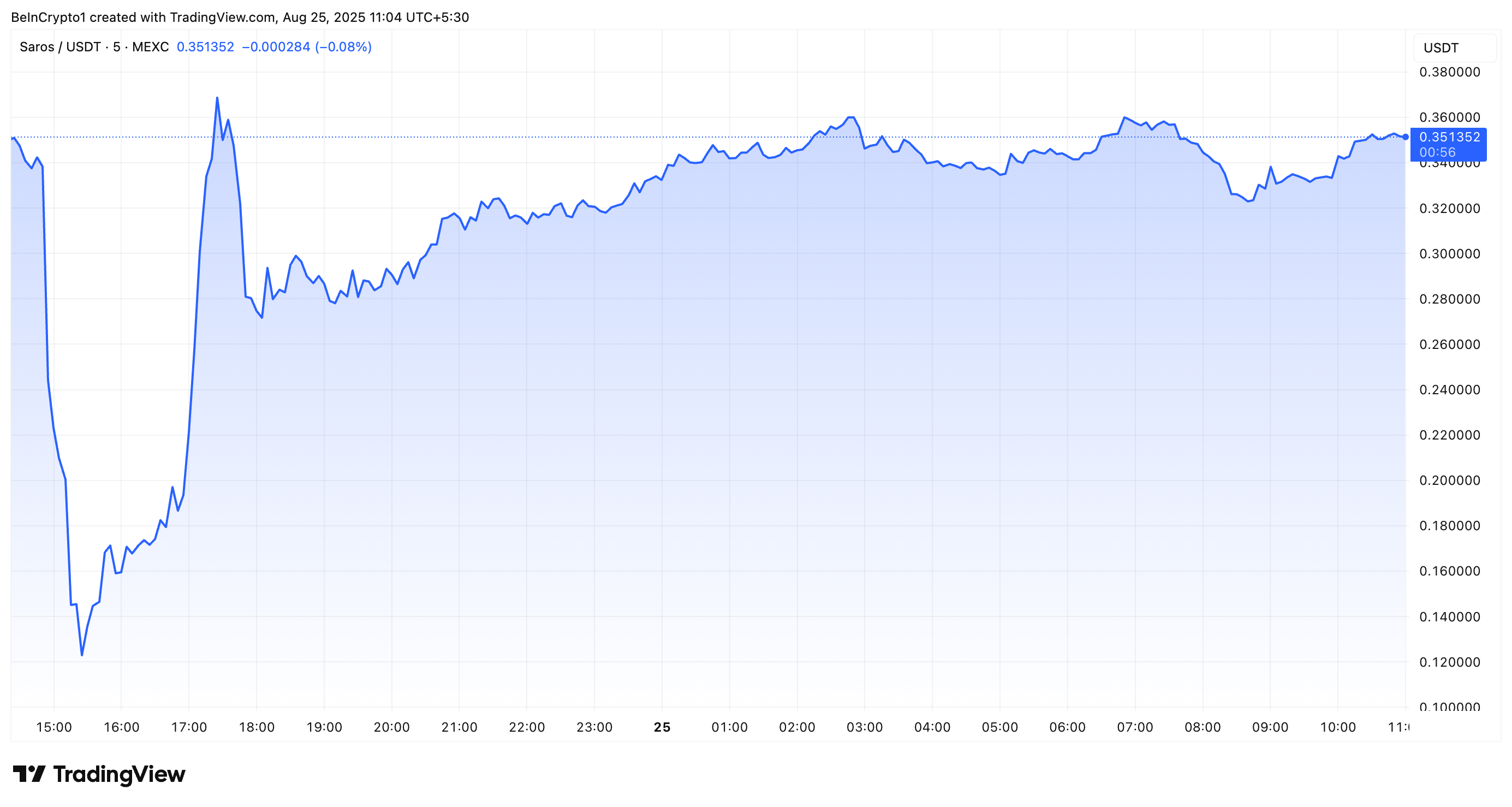 SAROS Price Crash. Source:
TradingView
SAROS Price Crash. Source:
TradingView
Nonetheless, the dip was brief. SAROS bounced back and reversed its losses. At the time of writing, it was trading at $0.35, down 5.3% over the past day.
Thanh Le, founder of Saros, addressed recent price volatility. He explained that the sharp moves in SAROS resulted from leveraged traders reducing their positions on centralized exchanges, which caused open interest to fall sharply.
“Based on our ongoing investigations and available data, we believe this is a market-driven adjustment, potentially involving a large, highly-leveraged position reducing its exposure on centralized exchanges (CEX). Prior to the movement, open interest was approximately 90M SAROS, according to exchange data, and it has since decreased to around 20M SAROS,” he said.
He stressed that neither the team nor long-term investors sold their holdings.
“Market cycles come and go, but our focus stays the same: building Saros into the liquidity backbone of Solana. Your trust and support are what drive us, and we’ll continue to keep you informed every step of the way,” Le added.
Despite this, the major crash caused many traders to lose money and shook the market sentiment. CoinGecko data showed that over 50% of the community is bearish on SAROS.
Welcome to crypto Never trade without a Stop-Loss! No matter how much profit you’re sitting on, one sudden move can wipe it all out.Just look at #SAROS — 142 days of gains erased in a single day dump.
— Crypto Tigers (@Crypto_Tigers1) August 24, 2025Risk management > Hype.
The volatility has reignited comparisons to OM, which experienced a 90% crash in April and has yet to recover completely.
“It’s going to keep falling for at least 1-2 years now…Whatever I said about OM before came true, and now whatever we said about Saros came true too,” an analyst remarked.
Surprise surprise$SAROS
— VIKTOR (@thedefivillain) August 24, 2025
Thus, this incident highlights the broader risks within the altcoin market. While SAROS has shown some recovery, the price drop has left many questioning the market’s stability. Now, the community will watch closely to see how Saros navigates this setback.
Disclaimer: The content of this article solely reflects the author's opinion and does not represent the platform in any capacity. This article is not intended to serve as a reference for making investment decisions.
You may also like
Multiple Factors Weigh In, Intensifying U.S. Treasury Sell-Off! 5-Year Yield Breaks 5% for the First Time Since 2007, 10-Year Yield Surpasses 5.1%
The stronger-than-expected U.S. September PMI, international crude oil prices returning above $100, and Fed governors signaling possible rate hikes have all negatively impacted the bond market. The disappointing 5-year Treasury auction has further worsened market sentiment. The psychological barrier of a 5% yield on the 10-year U.S. Treasury is losing its significance as a "ceiling," with the market now starting to discuss a potential 6%. In addition to rate hike expectations, fiscal and supply pressures are also driving up long-term bond yields.
According to reports, the Trump administration considered a 90-day diesel export ban, but this was later denied, with the US Secretary of Energy openly opposing it.
On Wednesday, according to Politico, the Trump administration was preparing a 90-day ban on diesel exports. Shortly after, Reuters reported that the United States was not preparing to implement such a ban. On the same day, the U.S. Secretary of Energy stated that banning diesel exports would "definitely not work," as it would force refineries to cut production, thereby driving up gasoline and jet fuel prices. After Politico's report, U.S. diesel futures fell by more than 7% before rebounding slightly, but the losses were not fully recovered.
Glassnode Has Turned Bullish on Bitcoin—They Revealed the Level They’re Waiting For
Arbitrum Price Surges as Robinhood Chain Revenue Soars — Can ARB Reach $0.30?
Crypto prices
More


