
BTCS rolls out Ethereum ‘bividend’ as NAV discount lingers

The company will pay a $0.05 dividend and a $0.35 ETH loyalty payout in ether
Ether treasury company BTCS is leaning into its “Ethereum-first” identity with a one-time blockchain dividend: a $0.05 per-share payout in ETH, plus an optional cash alternative for investors who don’t opt in.
The company also unveiled a $0.35 per-share loyalty payment — payable only in ETH — for holders who move shares to book entry with its transfer agent and keep them there through Jan. 26, 2026. Instead of your shares being held at your broker, they’re recorded in your name on the company’s official shareholder register.
Framed as both a reward and a balance-sheet signal, the move arrives while BTCS trades below its asset base. Management points to a $4.41 share price on August 15 against roughly $6.65 per share in cash and digital assets. That valuation gap also shows up in Blockworks Research’s mNAV (enterprise value / net asset value) tracker of Ethereum-treasury peers.
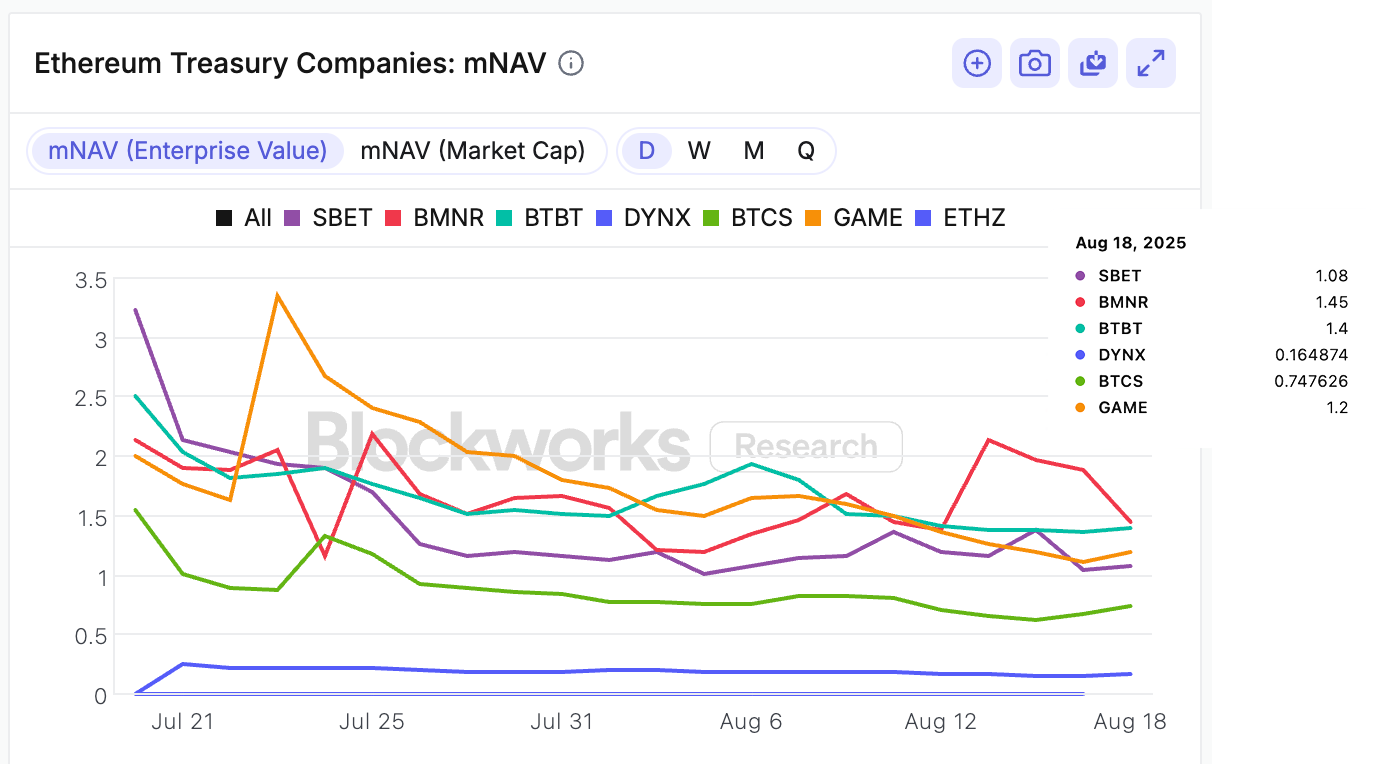 Source: Blockworks Research
As of Aug. 18, BTCS sat near the low end at ~0.75×, compared with SBET ~1.08×, GAME ~1.20×, and BMNR/BTBT ~1.40–1.45×; only DYNX was lower. In other words, the market is still assigning BTCS a below-peer multiple on its balance sheet.
CEO Charles Allen cast the program as both shareholder alignment and a shot across the bow against short sellers.
“As the largest shareholder of BTCS, let me be perfectly clear: my goal is to grow our market cap primarily through share price appreciation, not toxic dilution,” he wrote on X, adding that concentrating shares at the transfer agent is intended to make them harder to borrow for shorting.
Operationally, investors who want ETH must complete an opt-in at bividend.com and transfer shares to Equity Stock Transfer before the record date; otherwise, they’ll receive $0.05 in cash. The loyalty payment is paid after 120 days to those who keep shares in book entry for the full window.
Whether this closes BTCS’s valuation gap is the open question. The persistent mNAV discount suggests investors are still pricing execution risk around the company’s DeFi/TradFi “accretion flywheel,” ETH-denominated revenue exposure, and liquidity dynamics.
Still, paying out effectively a share dividend in ether is novel. If the program meaningfully shrinks lendable float and builds a stickier base, the multiple could drift toward peers. If not, BTCS will still have delivered a crypto-native distribution that puts real ETH in loyal holders’ wallets but, considering its shares have fallen about –40% over the past month, while ETH is up 20%, that may be a small consolation.
The record date for the “bividend” is Sept. 26, 2025. To qualify, you’d need to own shares by the close on Wed, Sept. 24 (or earlier).
Get the news in your inbox. Explore Blockworks newsletters:
- The Breakdown : Decoding crypto and the markets. Daily.
- 0xResearch : Alpha in your inbox. Think like an analyst.
- Empire : Crypto news and analysis to start your day.
- Forward Guidance : The intersection of crypto, macro and policy.
- The Drop : Apps, games, memes and more.
- Lightspeed : All things Solana.
- Supply Shock : Bitcoin, bitcoin, bitcoin.
Disclaimer: The content of this article solely reflects the author's opinion and does not represent the platform in any capacity. This article is not intended to serve as a reference for making investment decisions.
You may also like
Dow Jones Industrial Average bounces on Iran's latest Hormuz offer
U.S. stocks opened higher and fluctuated, the Japanese yen rebounded more than 1% intraday, 10-year U.S. Treasury yields broke above 5.22% again, and U.S. crude oil once fell nearly 3%.
After the release of U.S. consumer confidence data, the S&P and Nasdaq turned negative, while the Dow is poised to break a three-day losing streak but is set for a fourth consecutive weekly decline. Meta pulled back, falling more than 3% during the session. The U.S. 10-year Treasury yield surpassed 5.22% again, marking a new high for the third day in a row since 2007, while the 30-year yield reached its highest level since 2004. The yen/dollar pair surged 1.2% intraday, as Japanese and U.S. officials successively signaled concerns over the weak yen. Expectations for a diplomatic resolution between the U.S. and Iran are rising, halting crude oil's two-day climb.
US Treasury volatility surges, triggering alarms! BofA’s Hartnett warns of rising deleveraging risks as higher yields become main threat to the market
Bank of America strategist Michael Hartnett warns that the recent sharp rise in volatility in the US bond market is increasing the risk of broader deleveraging in financial markets.
U.S. diesel prices surge 83% this year! Apollo Chief Economist warns: Cost pass-through may make core inflation more stubborn, Federal Reserve can't ignore it
Torsten Slok, Chief Economist at Apollo Global Management, has warned that the inflation threat posed by the surge in U.S. diesel prices to historic highs may be more serious than the Federal Reserve currently realizes.
Crypto prices
More


