
KILO Drops Over 5% Despite KiloEx Resumption Plans: What Users Should Know

After the $7 million hack, KiloEx unveils a comprehensive compensation plan for affected users and prepares to resume operations. Despite the recovery efforts, the KILO token has fallen by over 5%.
Barely two weeks after a hacking incident compelled KiloEx’s suspension, the platform is staging a comeback and offering a compensation plan for affected victims.
The comeback highlights the platform’s resilience even as bad actors remain a consistent threat to the crypto industry.
How KiloEx Will Compensate Victims of $7 Million Hack
The YZi Labs-backed decentralized exchange (DEX) revealed the news in an X (Twitter) post, detailing how it would compensate victims.
“Due to the security incident on April 14, 2025, where KiloEx was exploited by a hacker, some user activities were affected. We are now announcing resolution plans for traders, Hybrid Vault stakers, and VIP users,” wrote the DEX.
In a follow-up Medium post, KiloEx detailed how it would unite traders, Hybrid Vault Stakers, and VIP users.
- Instructions for KiloEx Traders
Traders’ limit orders will be canceled while taking profit, and stop losses will be executed as normal. Traders whose positions remained open during the platform suspension will remain active after the KiloEx platform resumes. However, those whose losses increased or profits decreased during this suspension will be fully compensated for the difference.
“Please close your position as soon as possible after the platform resumes,” KiloEx directed.
This directive comes as DEX will calculate compensation based on the platform’s resume time. Accordingly, traders who delay their position closure could incur differences between their actual PnL (profit and loss) and the compensation amount.
- Instructions for Hybrid Vault Stakers on KiloEx
Hybrid Vault Stakers’ principal and earnings during the suspension period remain unaffected. The platform recovered and fully reinjected all stolen funds into the Hybrid Vault.
Nevertheless, KiloEx will still, based on eligibility, incentivize this cohort of users with a Special Yield Boost Campaign upon resuming.
“Users will receive an additional 10% APY on top of the base platform yield. The bonus yield will be paid out in USDT,” read an excerpt in the Medium post.
- Instructions for KiloEx VIP Users
For this cohort of KiloEx $7 million hack victims, there will be a +1 level upgrade, excluding VIP7 users. However, all affected users, including VIP7, will also get a 30-day VIP status protection period.
Notably, the VIP status was determined based on a real-time snapshot taken at the time of the KiloEx security incident.
KiloEx Details Resumption Plans After Audits and Consultation
BeInCrypto reported that KiloEx suspended its platform following the attack, amidst collaborations with security partners to investigate the breach and track stolen funds.
Like the Zksync incident, it also commissioned a bounty program to encourage whitehat assistance and recover user assets. Following these measures and due diligence, the platform is ready to resume operations.
“KiloEx is coming back! Following a thorough security audit by SlowMist, we are officially resuming soon,” the DEX shared.
Blockchain security firm SlowMist corroborated the report, detailing its involvement in resolving the KiloEx incident.
“Recently, SlowMist helped KiloEx communicate with the attacker via on-chain messages, leading to the recovery of $8.44 million in stolen funds,” SlowMist wrote.
Further, the security firm highlighted the role of on-chain messaging in the recovery, presenting it as a crucial communication tool in blockchain, including security incidents.
Despite the news about resumption and compensation, KiloEx’s native token, KILO, is down by over 5%. As of this writing, it was trading for $0.0425 on CoinGecko.
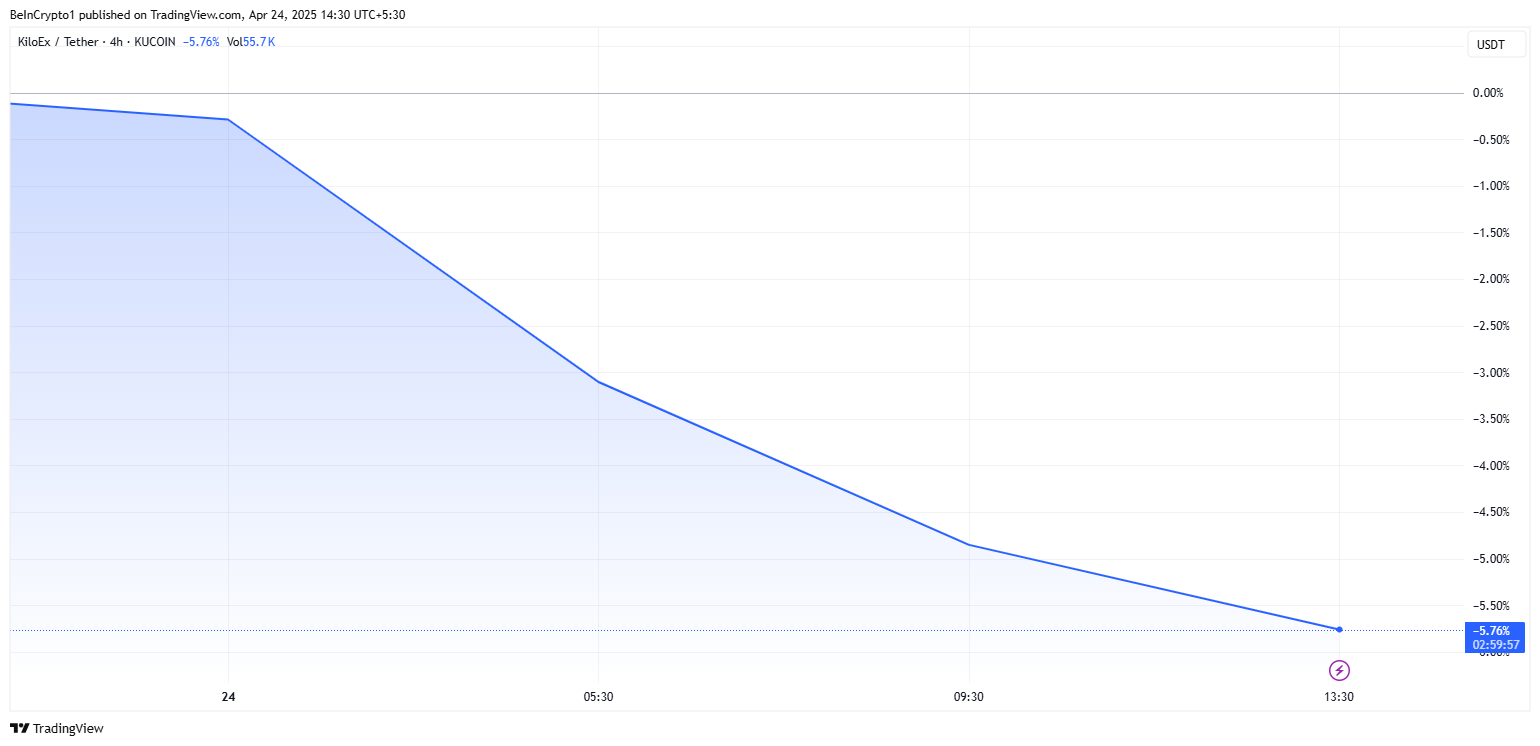 KiloEx (KILO) price performance. Source:
TradingView
KiloEx (KILO) price performance. Source:
TradingView
Meanwhile, it is worth noting that YZi Labs (formerly Binance Labs) incubated KiloEx. The DEX launched its token generation event (TGE) on March 27 in partnership with Binance Wallet and PancakeSwap.
Disclaimer: The content of this article solely reflects the author's opinion and does not represent the platform in any capacity. This article is not intended to serve as a reference for making investment decisions.
You may also like
AAVE Price Surges 16% as Tokenized Stocks Enter DeFi — Can AAVE Break $200?

Citibank: Nvidia's single GW revenue may rise from $18 billion to $40 billion, as AI infrastructure value continues to increase
A Citigroup report stated that Nvidia has added $150 billion in new share buyback authorization, raising its total buyback capacity to $235 billion by FY28, demonstrating confidence in AI-driven free cash flow growth. Meanwhile, the company is extending from GPUs to AI security, software, and full-stack infrastructure, with revenue per GW expected to rise from $18 billion in the Hopper era to $40 billion in the Rubin era.
SpaceX (SPCX.US) Starship reaches orbit for the first time, Wall Street unanimously bullish: Computing power leasing behind the scenes opens up valuation imagination
Wall Street's bullish outlook is not based on Starship, but on "computing power surpassing Starlink": SpaceX's computing power business is expected to overtake Starlink as early as the first quarter of 2027.
Crypto prices
More


