
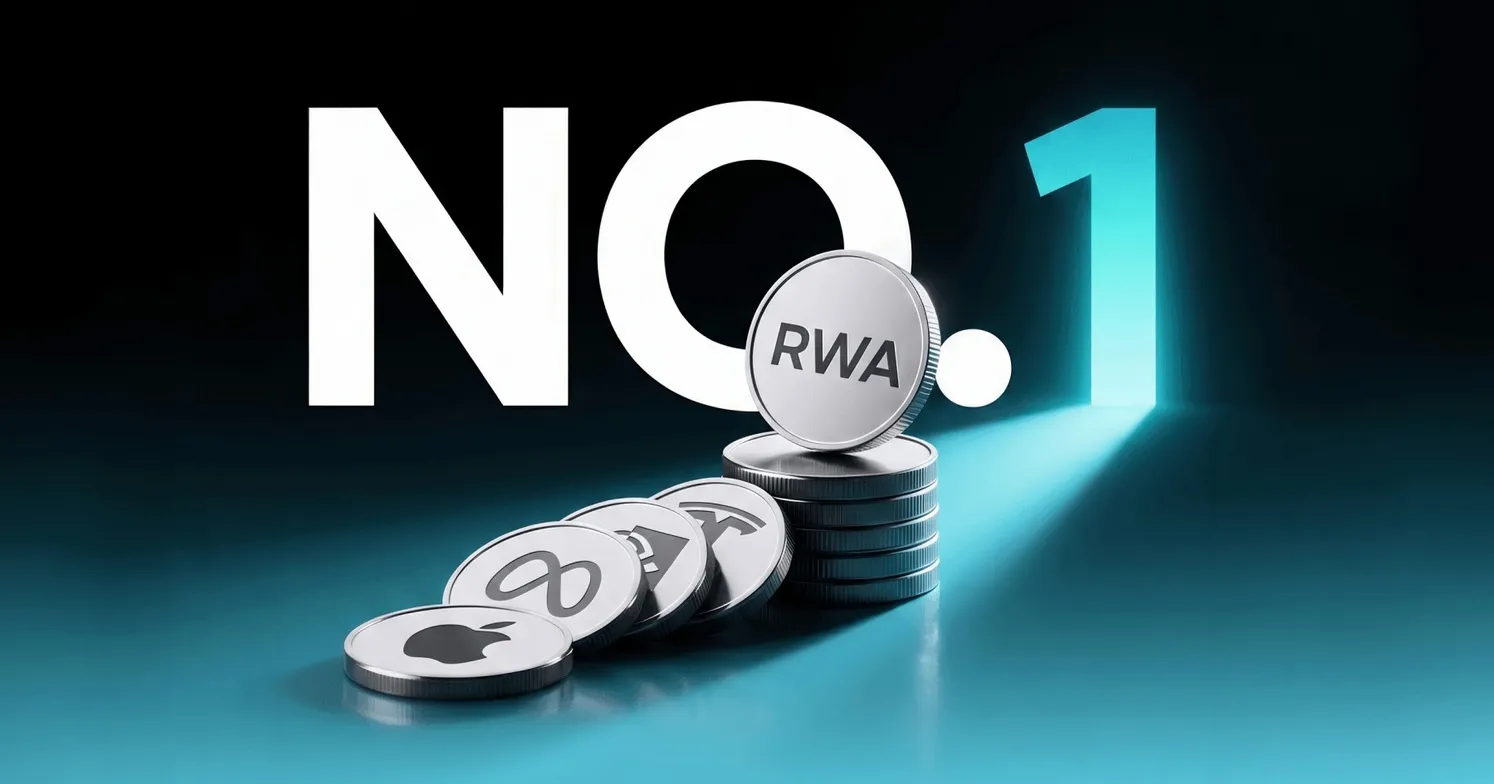
Case Study: How to Unlock Triple Returns With Bitget rToken
As crypto and traditional finance converge at an accelerating pace, capital efficiency has become one of the most critical edges for traders. Bitget's rToken (Bitget stock token), issued by Reality Protocol, is an innovative product built for this trend. It lets users gain exposure to U.S. stocks and ETFs using USDT, without ever leaving the crypto ecosystem. More importantly, rToken breaks the traditional limitation of assets that can only be held — turning one asset into multiple uses. A single rToken can do three jobs at once, dramatically boosting capital efficiency.
What is Bitget rToken?
rToken is a tokenized U.S. stock product issued by Reality Protocol, following the "r + ticker" naming convention — for example, rNVDA (NVIDIA), rAAPL (Apple), rTSLA (Tesla), rSPY and rQQQ (major ETFs). It currently covers over 500 mainstream U.S. stocks and ETFs.
Each rToken is designed to be pegged 1:1 to a real U.S. stock or ETF, with the underlying shares held by a FINRA-registered, SIPC-protected broker, and transparency is ensured through independent third-party audits and proof of reserves. Users can trade on Bitget using USDT to gain U.S. stock exposure — no need to convert to fiat or open a separate brokerage account.
How Bitget rToken turns one asset into three opportunities for maximum capital efficiency
Traditional stock holdings are often static — investors can only wait for price appreciation or dividends, resulting in low capital efficiency. Bitget's cross-asset unified trading account innovation turns eligible rTokens into efficient, multi-functional assets.
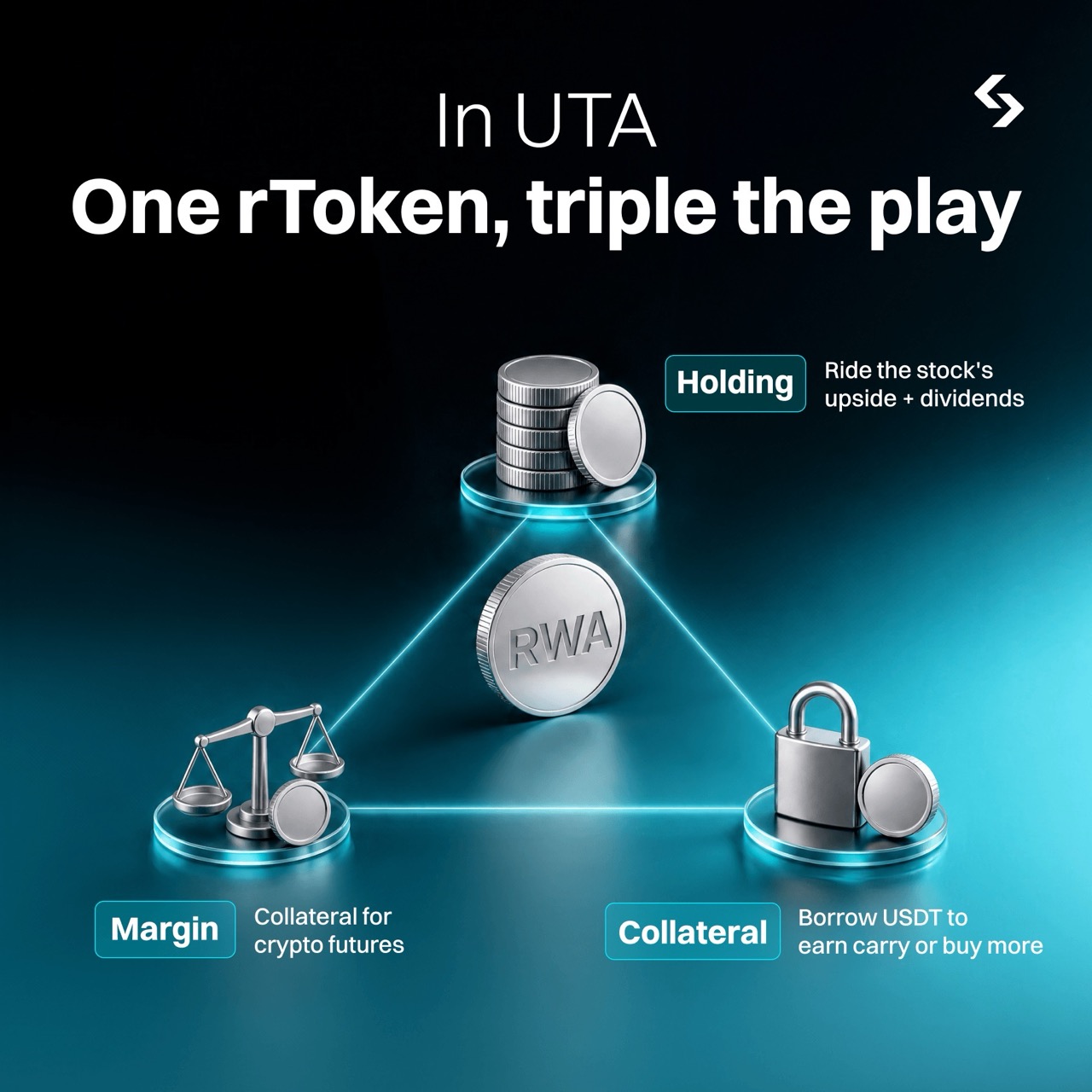
1. Hold exposure, earn U.S. stock returns
A single rToken directly reflects the economic performance of its underlying U.S. stock, including price movements and eligible dividends (distributed in USDT for easy reinvestment). Corporate actions such as stock splits are also handled automatically, with no extra steps required from users.
Scenario: A user, Alex, is bullish on the AI sector over the long term but doesn't want to frequently trade the underlying stock.
● Action: Buy 100 rNVDA with USDT and hold it in a Bitget account.
● How returns are generated::
○ Price increase: If NVIDIA's stock price rises 15%, rNVDA mirrors that economic performance, increasing Alex's position value by roughly 22,500 USDT.
○ Dividend distribution: If NVIDIA pays an eligible dividend, Bitget automatically distributes it to the user's account in USDT (after applicable fees), with no need to wait for traditional broker settlement — funds can be reinvested into crypto strategies immediately.
○ Automatic handling of corporate actions: For events such as stock splits, the rToken quantity/price is adjusted automatically, requiring no manual actions from users.
● Advantage: 24/7 trading support for popular tokens, allowing flexible adjustments even on weekends or when U.S. markets are closed; the underlying stock is pegged 1:1 and backed by broker custody and proof of reserves.
Result: Users retain full U.S. stock exposure and potential returns, while their assets remain freely liquid within the crypto ecosystem — unlike the isolation of a traditional brokerage account.
2. Use as margin for crypto trading
rToken can be counted toward Bitget's unified margin pool, supporting strategies such as futures, spot margin trading, grid trading, and copy trading. A single position can support margin trading and amplify capital efficiency, without needing to deposit additional USDT or sell off stock exposure.
Scenario: A user is bullish on rNVDA but also wants to capture volatility through crypto futures or grid strategies, without selling their position.
● Action: Within the Bitget unified trading account, the user can use 100 rNVDA as margin (with a relatively high collateral ratio, depending on the asset tier) and open a BTCUSDT perpetual futures position or enable an NVIDIA-related strategy directly, with no additional funds required.
● Specific example:
○ The user uses rNVDA as margin to open a 5–10x BTC short position as a hedge, or sets up a grid trading strategy to capture volatility.
○ If BTC drops in the short term, the futures position gains 10,000 USDT, while the rNVDA position continues to benefit from NVIDIA's rally.
○ If market volatility pushes the margin ratio close to a critical level, the user can adjust the position or add other assets at any time, without being forced to liquidate rNVDA.
● Advantage: Cross-asset unified margin lets stock exposure and crypto strategies work together seamlessly. One pool of capital backs both long exposure and leveraged derivatives, substantially boosting overall capital returns.
Result: The user's overall capital efficiency improves significantly — the same capital captures U.S. stock market exposure while also participating in high-frequency crypto strategies. It is not necessary to prepare two separate pools of funds as in the traditional model.
3. Use as collateral to unlock liquidity
Eligible rTokens can be pledged to borrow stablecoins, freeing up even more capital potential. Users can retain their U.S. stock exposure while borrowing funds for other opportunities — effectively making one dollar do the work of several. Collateral ratios can reach relatively high levels, and lending rates are updated in real time based on market conditions.
● Holders of memory-related rTokens (memory/storage semiconductor names, such as rMU for Micron and rSNDK for SanDisk) can use them directly as margin to open other stock perps positions within the UTA — for example, non-memory tech or broad-market perps such as NVDAUSDT, TSM-related perps, AAPLUSDT, or QQQUSDT.
Example scenario: A user who is bullish on the memory cycle long term holds 100 rMU. Without selling, they can use its margin value to open a 5–10x long or short position on NVDA or other AI supply chain stock perps, capturing relative strength or hedging exposure. If memory stocks continue to rise, the rMU exposure remains intact and may continue earning dividends, while the perps position captures moves in other names. If the margin ratio approaches a critical level, the user can add other assets or adjust the position at any time, without being forced to liquidate rMU.
● Conversely, holders of non-memory rTokens (such as rNVDA, rAAPL, rTSLA, rTSM, rQQQ, or rSPY) can also use them as margin to open memory-related stock perps positions, such as SNDKUSDT, MU-related perps, or other memory/storage perps.
Example scenario: A user holds rNVDA for AI leader exposure, while using it as margin to run relative-value trades on memory stock perps (going long or short on memory names), or to add to memory perps positions at a turning point in the memory cycle — all without depositing additional USDT or selling their NVIDIA exposure.
Capital efficiency and trading strategy highlights:
● Cross-asset capital reuse: The same rToken capital provides U.S. stock market exposure while also backing leveraged stock perps positions — combining exposure and derivatives amplification. There is no need to prepare two isolated pools of funds required in a traditional brokerage account.
● Relative value/hedging strategies: Spread trades and sector rotation between memory and non-memory names (or AI leaders vs. the storage cycle). For example, use rTSM/rNVDA as margin to short memory perps as a hedge, or use memory rToken margin to amplify a view on other tech stocks.
● Delta-neutral and funding rate arbitrage: Hold rTokens (spot) alongside a short position in the corresponding or related stock perps, hedge out directional risk, and earn the funding fee (potentially reaching double-digit annualized returns, depending on market conditions) — with the rToken itself serving as multi-asset margin, reducing the need for additional USDT.
● 24/7 flexibility: Popular names support 24/7 trading and adjustments, so users can manage margin and positions even on weekends or when the U.S. market is closed; corporate actions (such as splits) are mapped automatically and don't affect margin calculations.
● Higher overall returns: One pool of capital captures U.S. stock gains and dividends while also backing high-frequency or leveraged strategies, delivering far higher capital efficiency than the traditional "buy and hold" model. Risks to be aware of: Collateral ratio discounts, margin calls or liquidation triggered by volatility, and leverage amplifying risk in both directions. Actual parameters are subject to real-time platform data — it's advisable to start with lower leverage and manage risk carefully.
Closing thoughts
Bitget rToken is more than just tokenized U.S. stocks — it's an upgrade to capital efficiency itself. One rToken does three jobs: Earning holding returns, backing trades, and unlocking liquidity through lending, so every dollar of capital delivers maximum value. As crypto and TradFi continue to converge, this is the direction asset management is heading.


- What is Bitget rToken?
- How Bitget rToken turns one asset into three opportunities for maximum capital efficiency
- Closing thoughts
 TradFi Weekly Recap (October 19 - October 23)2026-10-22 | 15m
 US30: The AI Crash Is Fueling the Dow's Breakout2026-10-22 | 5m