

Understanding the SpaceX Unlock Schedule
SpaceX officially went public on June 12, 2026, opening a new chapter in the capital markets. After the IPO, a significant amount of shares held by core shareholders, early employees, and investors will become unlocked (as lock-up periods end), which directly affects secondary market supply and stock price trends. Based on public IPO roadshow materials, SEC filings, and market data, here's a clear breakdown of the complete unlock schedule.
Key SpaceX unlock milestones
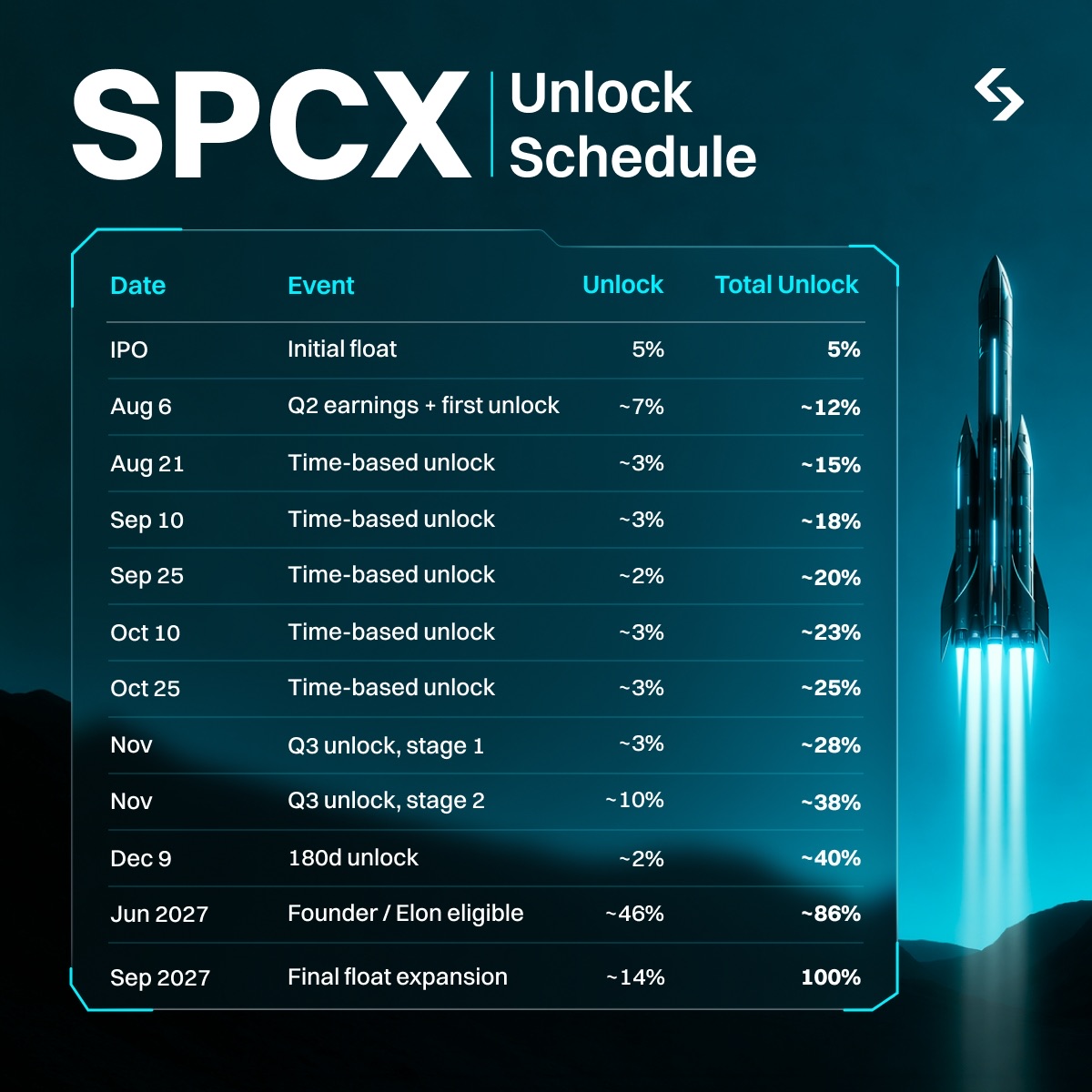
● Initial IPO float: 5% float, 5% total unlocked. Low-float stage.
● First wave (August 6): Q2 earnings + first unlock of 7%, 12% cumulative.
● Ongoing small-batch unlock period (late August – October): Multiple rolling unlocks of 2–3%, gradually raising the cumulative total to 25%.
● Q3 unlock (November): Two stages (3% + 10%), reaching 38% cumulative.
● 180-day unlock (December 9): An additional 2% unlocked, reaching 40% cumulative.
● Founder/Elon eligibility unlock (June 2027): A large 46% unlock, reaching 86% cumulative. This is the milestone the market is watching most closely.
● Final float expansion (September 2027): The last 14%, reaching 100%.
Detailed SpaceX unlock schedule
|
Milestone
|
Estimated date
|
Unlock ratio
|
Cumulative unlock
|
Notes / Significance
|
|
Initial IPO float
|
IPO date
|
5%
|
5%
|
Initial float
|
|
Q2 earnings + first unlock
|
August 6
|
7%
|
12%
|
First unlock wave
|
|
Time-based unlock
|
Aug 21
|
3%
|
15%
|
Small-batch rolling unlock
|
|
Time-based unlock
|
September 10
|
3%
|
18%
|
Small-batch rolling unlock
|
|
Time-based unlock
|
September 25
|
2%
|
20%
|
Small-batch rolling unlock
|
|
Time-based unlock
|
October 10
|
3%
|
23%
|
Small-batch rolling unlock
|
|
Time-based unlock
|
October 25
|
3%
|
25%
|
Small-batch rolling unlock
|
|
Q3 unlock, stage 1
|
November
|
3%
|
28%
|
Q3 stage 1
|
|
Q3 unlock, stage 2
|
November
|
10%
|
38%
|
Q3 stage 2 (larger unlock)
|
|
180-day unlock
|
December 9
|
2%
|
40%
|
180-day milestone
|
|
Founder / Elon eligibility
|
June 2027
|
46%
|
86%
|
Core major milestone (Elon and other founders)
|
|
Final float expansion
|
September 2027
|
14%
|
100%
|
Full float achieved
|
Reference total share count: Approximately 13.076 billion shares.
Impact of the unlocks on SpaceX's stock price
As of August 6, 2026 (the first unlock wave date), the market is about to enter a small-batch, high-frequency unlock period. Here's a general outlook on how this could affect SpaceX's stock price:
1. Potential sources of short-term pressure
● The August 6 first unlock wave (7%): This is the first major single unlock since the IPO, pushing the cumulative float from 5% up to 12%. Historically, high-profile IPOs like this often see pre-unlock front-running sell pressure or amplified volatility on/right after the unlock date. If overall market sentiment is weak or risk appetite for U.S. stocks declines, a short-term pullback is fairly likely.
● Consecutive small unlocks from August 20 through the end of October (2–3% each time): While each individual unlock is small, the frequency (roughly every 2–3 weeks) creates a steady backdrop of continuous supply. This kind of pattern rarely triggers a single-day crash, but it can lead to choppy, sluggish price action or an inability to break higher.
● The November Q3 unlock (3% + 10%) and the December 8 180-day unlock (3%): The 10% single unlock in November, combined with an additional 3% in December, represents one of the more notable pressure windows within 2026. If the stock has already pulled back from highs by then, or if fundamentals (earnings, orders, valuation) fail to beat expectations, the pullback could be larger.
2. Potential buffers or positive factors
The unlocks aren't a one-time shock — they're spread out over time, giving the market room to absorb them.
If SpaceX's fundamentals remain strong (launch frequency, Starlink subscriber growth, improving profitability, etc.), institutional buying and passive fund flows (if included in relevant indices) could help partially offset selling pressure.
The early float remains relatively limited (only reaching about 40% by December), meaning the potential for extreme sell-offs is theoretically lower than once the float is fully unlocked.
3. What traders should pay special attention to
● Key dates: August 6, August 21, September 9, September 24, October 9, October 24, November (Q3's two stages), and December 8. Trading volume and volatility typically rise in the 1–3 trading days around these dates. Short-term traders should plan their positions and stop-losses ahead of time, avoiding chasing highs or panic-selling on unlock days.
● Don't just look at the unlock percentage: Actual selling pressure depends on how much unlocked shareholders actually choose to sell. Early employees and some investors may want to cash out, but if the stock is trading near highs with solid fundamentals, actual selling could end up below the nominal unlock ratio.
● Watch for concurrent news: If earnings reports, major contracts, regulatory news, or broader market systemic risk coincide with an unlock date, the impact can be amplified. It's a good idea to track official disclosures and SEC filings alongside the schedule to confirm the actual number of tradable shares.
● Liquidity and spread: Since the float is still gradually increasing, you may see wider bid-ask spreads or temporary liquidity shortages intraday, especially outside normal U.S. stock trading hours. Using limit orders and keeping position sizes controlled is a safer approach.
● Prioritize risk management: The unlocks create structural pressure from increased supply — they don't guarantee a price decline. Short-term traders might consider reducing positions ahead of an unlock and observing how the market absorbs the new supply afterward, or setting clear stop-loss levels and position caps. Longer-term holders should focus more on whether fundamentals can keep pace with the gradually expanding float.
How to Trade SpaceX U.S. stock on Bitget
Following SpaceX's (Nasdaq: SPCX) IPO, Bitget stocks market was among the first to list the related trading asset — rSPCX. rSPCX is a spot product launched in partnership with Reality, designed to track SpaceX's stock price, liquidity, and dividends on a 1:1 basis, with support for 24/7 trading and fractional (small-share) trading. The current trading pair is rSPCX/USDT.
Step 1: Sign up and log in to Bitget, complete identity verification, and deposit funds
1. Sign up and log in to your Bitget account
○ Download the official Bitget app (recommended) or visit the official website.
○ Sign up using your email, phone number, or Google account, set a strong password, and enable 2FA (Google Authenticator) for added security.
2. Complete identity verification
○ While some features may not require complete identity verification, it's recommended to complete intermediate or advanced verification to raise your withdrawal limits and access more products (policies may vary by region).
3. Deposit USDT to your spot account
○ Recommended method: Buy USDT via P2P (over-the-counter trading), which supports bank cards, credit cards, and more, with low fees.
○ Other methods: Transfer USDT from another wallet (the TRC20 network is recommended for lower fees and faster speed).
○ After the transfer, make sure the funds are in your spot account.
Step 2: Go to the Bitget spot trading page
App (recommended):
● Tap Trade in the bottom navigation bar, then select Spot.
● Enter rSPCX or rSPCX/USDT in the search bar and tap to enter the trading page.
Website:
● After logging in, click Trade at the top, select Spot, and search for rSPCX/USDT.
Trading tips and risk management
● Fees: Keep an eye on platform promotions (such as zero-fee promotions); standard spot transaction fees are usually low.
● Position management: rSPCX supports automatic adjustments for dividend tracking and stock splits, making it suitable for medium- to long-term holding.
● Risk warning:
○ Crypto assets are highly volatile, and SpaceX-related products are affected by the company's fundamentals, the U.S. stock market, and regulatory factors.
○ Only trade with funds you can afford to lose, and set stop-losses (for example, capping losses on a single trade at 1–2% of your total capital).
○ Leveraged products (if available) amplify risk and should be used with caution by beginners.
○ Platform availability may be restricted by region — make sure trading this product is permitted in your location.
● Withdrawals/transfers: After trading, you can transfer rSPCX or USDT to another wallet, or sell via P2P to cash out.
Summary
● Second half of 2026: Starting from August 6, the market enters a period of ongoing small-batch unlocks, typically ranging from 2–7% at a time. Supply pressure remains relatively manageable, but the cumulative float will gradually rise to 40% by December 8.
● First half of 2027: The large 46% founder/Elon unlock on June 12 is the true key milestone to watch, followed by the final 3% completed in September.
● Actual dates may shift due to trading day adjustments or company announcements; official disclosures should always be considered the final source of truth.
The SpaceX unlock isn't a one-time shock — it's a staged, phased, and gradual release process. 2026 is more of a gradual test, while 2027 is where the real test begins, especially Elon Musk's massive unlock milestone in June 2027, which will be the most important window to watch in the secondary market.


- Key SpaceX unlock milestones
- Impact of the unlocks on SpaceX's stock price
- How to Trade SpaceX U.S. stock on Bitget
- Summary

 TradFi Weekly Recap (October 19 - October 23)2026-10-22 | 15m
 US30: The AI Crash Is Fueling the Dow's Breakout2026-10-22 | 5m