
AI Capex Concerns Trigger Tech Sell-Off: NAS100 Slides Sharply as Semiconductors Come Under Pressure
U.S. technology stocks faced a notable sell-off as concerns resurfaced over the artificial intelligence (AI) sector’s massive capital expenditure, financing capacity, and future return on investment. The tech-heavy Nasdaq Composite fell around 2.6% in a single session, while semiconductor stocks suffered even steeper losses, with the Philadelphia Semiconductor Index dropping more than 6%.
It is worth noting that NAS100 primarily tracks large non-financial constituents of the Nasdaq-100 Index and is not identical to the Nasdaq Composite. However, because selling pressure in this move was concentrated in mega-cap technology, AI chips, data centers, and cloud infrastructure supply chains, NAS100 also came under significant pressure.
Market Focus: AI Spending Shifts From a Growth Driver to a Valuation and Financing Test
The core driver behind this sell-off was not weak earnings from a single company. Instead, the market has begun reassessing three key questions surrounding the AI investment cycle:
1. Are companies spending too aggressively on AI infrastructure?
2. How will these long-term spending commitments be financed?
3. When will massive capital expenditure translate into stable revenue and free cash flow?
Although Meta reported revenue and earnings above market expectations, its shares still fell approximately 6.98% after the earnings release. Investors focused on the company’s rising AI infrastructure spending and its future lease and contractual payment commitments.
According to market data, Meta’s future lease and contractual commitments over the coming years total approximately US $825 billion, up from nearly US $700 billion disclosed previously. While this figure does not represent capital expenditure for a single year, the scale of these long-term payment obligations has prompted investors to reassess the company’s future cash flow, debt burden, and credit risk.
Financing Concerns Spread as the AI Supply Chain Faces Valuation Pressure
The AI theme had previously driven a powerful rally in U.S. technology stocks. However, when markets begin to worry about financing costs and the payback period for capital expenditure, capital often exits sectors with higher valuations and more aggressive growth expectations first.
Meta’s credit default swap (CDS) spreads rose notably at one point, while its corporate bonds weakened relative to U.S. Treasuries. This reflected increased market sensitivity to the company’s spending plans and financing risks.
Meanwhile, Nvidia CEO Jensen Huang noted that demand from emerging cloud service providers remains exceptionally strong, but constrained capital supply could limit industry expansion. While this highlights continued demand for AI computing capacity, it also reminded markets that strong demand does not mean financing pressure has disappeared.
For traders, the next focus across the AI supply chain may not be limited to “how many orders are being placed,” but also whether companies can finance expansion effectively and convert that expansion into sustainable profits.
Semiconductor and Data Center Supply Chains Become the Center of Selling Pressure
During this technology sector pullback, semiconductors, semiconductor equipment, optical communications, and memory chip stocks were among the hardest-hit areas.
Several key AI supply chain names saw significant declines:
-
TSMC ADR (TSM) fell about 4.52%, closing at US$412.35
-
Nvidia (NVDA) declined about 4.40%
-
Amazon (AMZN) fell about 4.57%
-
Alphabet/Google declined about 3.15%
-
Micron (MU) dropped about 6.26%
-
Applied Materials (AMAT) fell about 8.16%
-
Lam Research (LRCX) declined about 11.76%
-
Coherent (COHR) and Lumentum (LITE) both fell by more than 10%
Pressure on semiconductor equipment and optical communications stocks reflects growing concerns that, if data center construction slows, spending on equipment, optical modules, and memory could be among the first areas to face cutbacks.
Memory-related stocks have been especially volatile, with recent pullbacks already becoming substantial. As optimism around AI capital expenditure cools, stocks that delivered strong prior gains may be more vulnerable to profit-taking and valuation corrections.
Why Is NAS100 Particularly Sensitive?
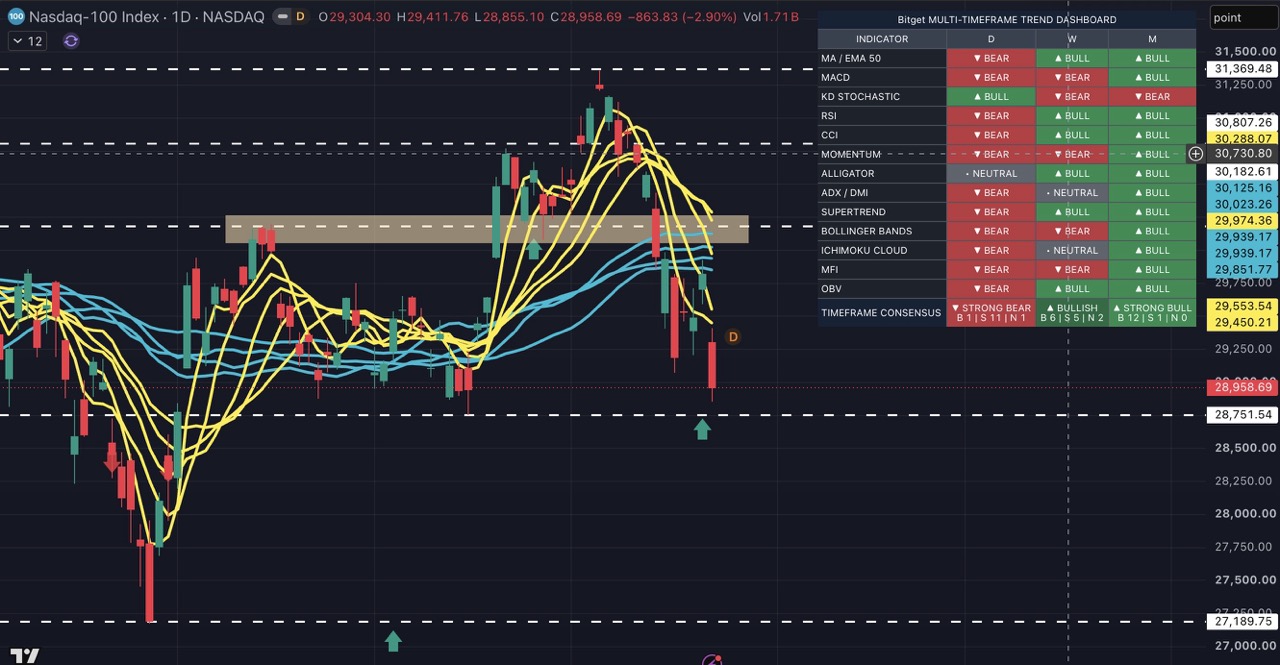
NAS100 is heavily concentrated in mega-cap technology companies, semiconductors, internet platforms, cloud services, and consumer technology names. As a result, when markets become concerned about AI spending and valuations among major technology companies, NAS100 tends to experience amplified volatility compared with more traditional value-oriented indices.
The market divergence during this session was clear:
-
The Nasdaq Composite fell around 2.6%
-
The SP 500 declined about 1.2%
-
The Dow Jones Industrial Average was broadly flat
This suggests that selling pressure was concentrated in high-valuation technology growth stocks rather than reflecting broad-based systemic panic. Defensive sectors such as consumer staples, healthcare, and utilities proved relatively resilient, indicating an ongoing rotation in market leadership.
For NAS100 traders, it is important not only to monitor key support and resistance levels on the index itself, but also to track major weighting stocks and sector indicators, including Nvidia, Meta, Amazon, Alphabet, TSMC ADR, and the broader semiconductor index.
Treasuries, Oil Prices, and Geopolitics Add Further Complexity
Beyond AI financing concerns, several macroeconomic factors have also added to market uncertainty.
On one hand, rising risk aversion supported demand for U.S. Treasuries, causing the 10-year Treasury yield to fall sharply at one point. Lower yields would normally support high-valuation technology stocks, but in the current environment, the market is more focused on what safe-haven flows imply about weakening risk appetite.
On the other hand, escalating geopolitical tensions pushed international oil prices higher. Rising oil prices could reignite inflation concerns and increase uncertainty surrounding corporate costs and monetary policy. For technology stocks, if inflation pressure keeps interest rates elevated for longer, high price-to-earnings multiples and growth valuations could face additional headwinds.
U.S. initial jobless claims also fell to 194,000, a three-month low, indicating that the labor market remains resilient. While this supports the broader economic backdrop, it could also reduce expectations for rapid interest-rate cuts.
What to Watch Next: Is the AI Trade Entering a “Fundamental Validation” Phase?
In the near term, volatility in technology stocks and NAS100 may remain elevated. Markets will likely focus on several key factors:
1. Capital Expenditure Guidance From Mega-Cap Technology Companies
If more cloud giants continue raising AI data center investment plans, investors will demand greater clarity on investment returns and free cash flow performance.
2. Whether Credit Market Conditions Continue to Deteriorate
Corporate CDS spreads, credit spreads, and high-yield bond market performance will be important indicators of whether AI-related financing risks are spreading.
3. Whether Semiconductor and Equipment Stocks Can Stabilize
Semiconductor stocks are often a leading indicator of market risk appetite. If the Philadelphia Semiconductor Index remains weak, the upside potential for a NAS100 rebound could be limited.
4. U.S. Interest Rates and Oil Price Movements
Treasury yields, the U.S. dollar, crude oil prices, and inflation expectations will continue to influence technology valuations and overall market risk appetite.
JPMorgan’s strategy team has suggested that long positioning in semiconductors may have already been significantly reduced, which could potentially limit further downside. However, this does not mean that market risks have fully disappeared. Until AI financing, corporate spending, and earnings delivery are more clearly validated, short-term volatility in technology stocks may remain elevated.
Conclusion: NAS100 Enters a High-Volatility Phase, Making Risk Management More Important
The latest sharp decline in U.S. technology stocks is a reminder that the AI investment theme is moving beyond a simple growth narrative and into a stricter testing phase focused on capital expenditure, cash flow, and financing capacity.
For NAS100 traders, this is not a time to focus solely on individual bullish or bearish headlines. It is important to assess earnings from major technology companies, semiconductor trends, credit market risks, U.S. Treasury yields, and oil price movements together. In a high-volatility environment, setting clear stop-loss levels, controlling leverage, and managing position size are more important than chasing short-term price action.
Trade NAS100 Volatility Flexibly With Bitget CFD
When technology stocks experience sharp price swings, CFDs can allow traders to position for potential upside or downside moves based on their own market view. With Bitget CFD, you can follow real-time movements in popular markets such as NAS100 and use two-way trading opportunities to respond to volatility driven by earnings, interest rates, AI industry developments, and geopolitical events.
Visit Bitget CFD today to follow NAS100 and global market movements and build a trading strategy that fits your market outlook.
All trading education provided by Bitget is for educational purposes only and should not be considered financial advice. The strategies and examples shared are for reference only and may not reflect actual market conditions. CFD trading involves significant risk, including the potential loss of capital. Past performance does not guarantee future results. Please conduct thorough research and ensure that you understand the risks involved. Bitget is not responsible for any trading decisions made by users.


- Market Focus: AI Spending Shifts From a Growth Driver to a Valuation and Financing Test
- Financing Concerns Spread as the AI Supply Chain Faces Valuation Pressure
- Semiconductor and Data Center Supply Chains Become the Center of Selling Pressure
- Why Is NAS100 Particularly Sensitive?
- Treasuries, Oil Prices, and Geopolitics Add Further Complexity
- What to Watch Next: Is the AI Trade Entering a “Fundamental Validation” Phase?
- Conclusion: NAS100 Enters a High-Volatility Phase, Making Risk Management More Important